
Last week I had a two-feature brief ready for my finetwork MCP server, invoice PDF downloads and monthly spending alerts pushed to the user. It looks fine. It's also impossible. MCP servers over stdio have no push channel, so "pushed to the user" can't mean what I wrote.
No agent would have told me that. It would have built immediately and left me reading confident, well-formatted code for the wrong thing.
Then I handed the brief to a skill whose entire job is to ask first. grill-with-docs lives in Matt Pocock's 159k-star skills repo, is six lines of markdown long, and refused to plan anything until it questioned me about my own server.
A skill that interviews you
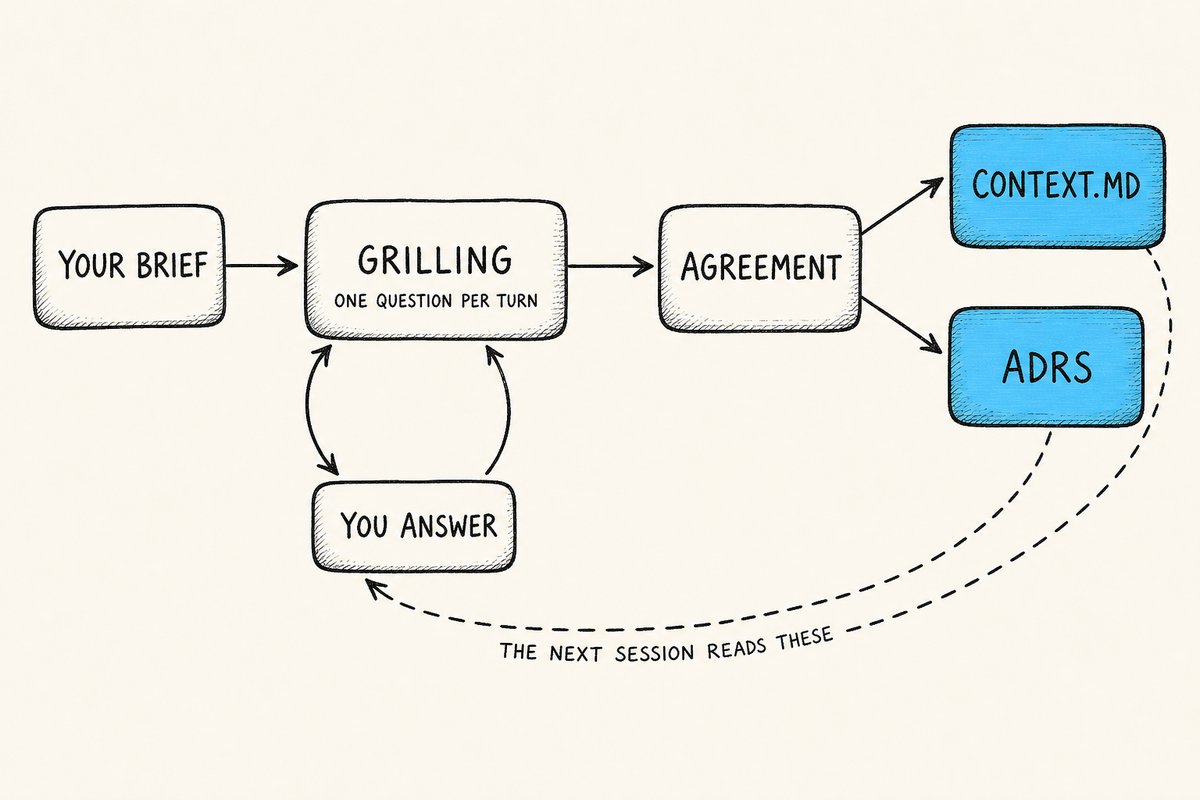
You give grill-with-docs a rough feature description and instead of coding it interviews you, one question per turn with a recommended answer, until the design is settled. The answers become two files that survive the chat, a CONTEXT.md glossary for your project's vocabulary and Architecture Decision Records for choices that would surprise a future reader.
The six lines themselves only point at two sub-skills. The grilling skill holds the interview engine, which requires facts from the repo, not from you, and forbids building until you confirm shared understanding. The domain-modeling skill holds the documentation rules, with an ADR gate that only accepts decisions hard to reverse and carrying a real trade-off.
63 seconds to the real problem
I started it with one line.
/grill-with-docs I want to add two features to this MCP server: downloading invoice PDFs, and monthly spending alerts pushed to the user
In 63 seconds it read my source and README, opened with "Quick facts I gathered so I don't have to ask you about them", and named the stdio problem before asking me anything. The impossible push feature turned into an external scheduled agent that calls the server monthly, and question one alone justified the session.
When I answered "I don't know" in later turns, it made its own choice and moved on. CONTEXT.md appeared mid-session, only one decision passed the ADR gate, and the whole run, interview plus implementation, cost $8.54.
My hardest fact came out of src/index.ts, and I wrote that file. The skill earns its keep on code you don't fully hold in your head, and on cutting scope to something you can build.
The stop gate and the ADR that lied
By turn 6 I got impatient on purpose. I sent one message that broke the glossary, added multi-account support for my flatmate, a branch no question had touched, and closed with "just start coding it now", which every product owner I have worked for eventually says.
The grilling spec tells it not to build until the user confirms shared understanding.
It coded everything immediately. Five minutes later I had a multi-account credentials schema invented on its own and the glossary-breaking name, and neither branch got marked as never grilled. The glossary is a record, not a guard.
The next failure needed a fresh session, which opened with the best thing the skill did all week. It read the earlier CONTEXT.md and ADR on its own and reasoned from them before I asked anything. That was the moment it clicked. The docs stopped being a file format and became a colleague with memory.
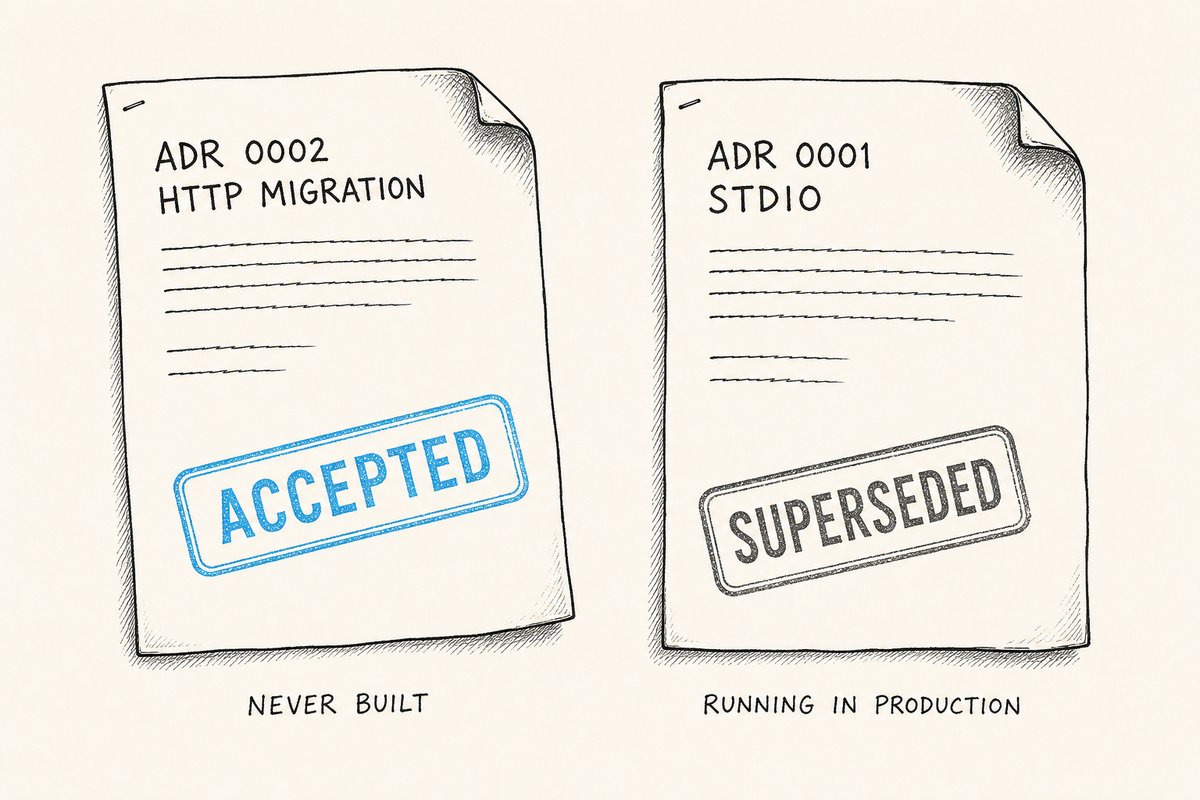
Then I grilled a hypothetical stdio-to-HTTP migration and said I would build it some other month. It wrote the new ADR as accepted and marked the ADR for the architecture running today as superseded. Anyone reading docs/adr/ now believes the unbuilt design is in use. The prose is careful and correct. The machine-readable fields lie.
What a one-line prompt cannot do
The recurring skeptic argument is "that's literally it", a prompt you could type yourself. So on a clean clone I typed one sentence, and it delivered most of the interview for much less.
What the prompt cannot do is persist. When the chat ends everything is lost, while my second session started already informed, and those persistent docs are exactly where the ugliest failures live.
If you try it, budget fifteen minutes on a sandbox copy of a repo you know well. The official npx skills installer drops the skills in a folder Claude Code never reads, so you must link the skill folders into your project by hand or /grill-with-docs only returns "Unknown command".
Then hand it a brief missing details on purpose, answer one question with "I don't know", and don't say "just start coding" unless you mean it.
The top comment on the launch video, 503 likes, reads "AI is really just a way to trick engineers into writing good documentation." It is more true than intended. The trick works, and then the docs it tricked you into writing need a code review of their own. I'm keeping it anyway, with that review as a fixed rule.
Before you run it
- The interview deserves the stars. It found my architecture's real constraint in 63 seconds, from a one-line brief.
- The stop gate is softer than the spec. "Just start coding it now" broke it, and never-grilled scope got built without a warning.
- Never trust an ADR status field it writes. Mine marked unbuilt work accepted and the live architecture superseded.
- A one-sentence prompt gets you most of the interview. The persistent docs are what you're paying for, so review them like code.